SOFF X · AIHujjatingizni AI yaratsinSovg'ani oling
Mahsulot tavsifi
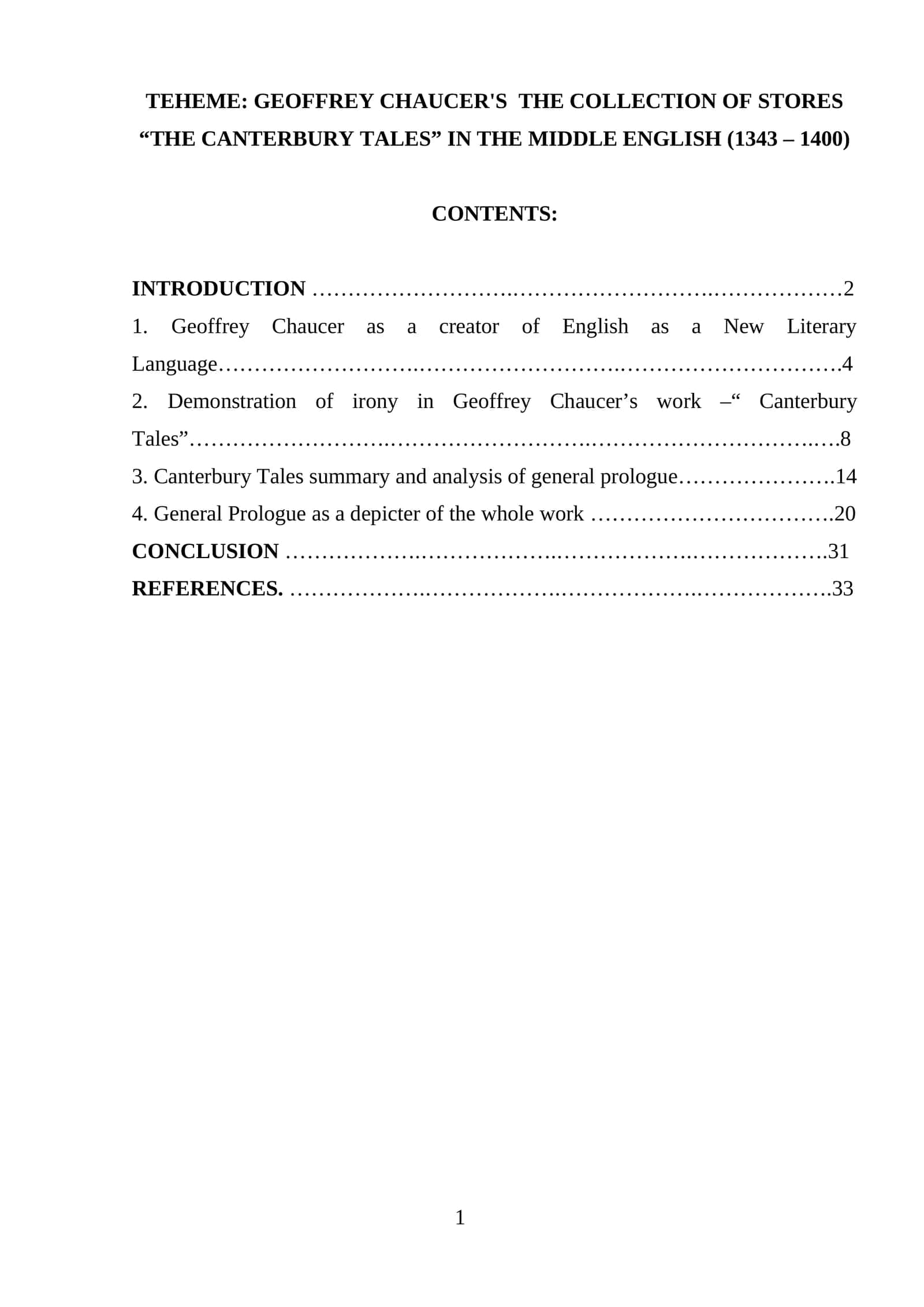
This course work presents a systematic study of Geoffrey Chaucer's "The Miller's Tale" from The Canterbury Tales, examining it through the lenses of comedic theory, medieval philosophy, and rhetorical analysis. The paper explores how Chaucer employs the fabliau genre to safely breach ideological boundaries surrounding human knowledge and authority in fourteenth-century England. The work consists of an introduction, two chapters, and a conclusion. Chapter One provides the general background of Chaucer's life, detailing his biography, education, career as a courtier and diplomat, and the chronological development of his major works, including The Book of the Duchess, Troilus and Criseyde, and The Canterbury Tales. This chapter also examines the comedic structure of The Canterbury Tales as a whole, analyzing medieval conceptions of comedy as distinct from mere humor, drawing on theoretical frameworks from Dante, Boethius, Bakhtin, and Northrop Frye to demonstrate how the work moves from discord toward harmony. Chapter Two focuses specifically on "The Miller's Tale" and its companion pieces, "The Reeve's Tale" and "The Man of Law's Tale," providing detailed summaries and critical analysis. The chapter examines the tale's use of incongruity, characterization, and comic justice, alongside its relationship to medieval concepts of eschatology and scatology. Special attention is given to the significance of character names, vocations, and symbolic elements that connect the tale to biblical narratives, particularly the story of Noah's flood. The study argues that beneath its bawdy surface, "The Miller's Tale" contains a Boethian philosophical perspective that questions the imperfect nature of human knowledge and authority, using humor and the fabliau form as a vehicle for serious social and philosophical critique. The paper demonstrates that Chaucer's rhetorical choices—including layers of narrative distancing, generic conventions, and comic devices—allow potentially subversive ideas to be communicated safely within an authoritarian medieval society. This research contributes to Chaucer scholarship by synthesizing multiple theoretical approaches to illuminate the tale's deeper "sentence" (meaning) beneath its comic surface, making it valuable for students and researchers of medieval English literature, translation studies, and literary analysis.
Muallif

- Hujjatlari
- 511
- Sotilgan
- 234